Early-access calibration platform

A connected calibration workflow. Ready to explore.

Explore a demonstrated path from work order and worksheet to review and PDF certificate. CalBrix is in early access: demos use synthetic data, and customer production use requires further validation.

Indicative implementation scopes from $5,000, subject to feasibility and written agreement. Hosting, maintenance and other operating costs are separate.

Calibration laboratories

Evaluate client work orders, procedure-based worksheets and PDF certificate output.

Oil & gas operations

Discuss pressure, temperature and flow workflows; field and safety-critical use need separate validation.

Mining and power plants

Explore instrument records and planning needs for industrial sites.

Multi-site industrial teams

Assess site structure, permissions and deployment requirements before a rollout.

CalBrix demo dashboard with synthetic records; displayed statistics are illustrative
Demo assetsDemo work ordersTest certificatesSynthetic data

Built for

Calibration laboratories

Evaluate client work orders, procedure-based worksheets and PDF certificate output.

Built for

Oil & gas operations

Discuss pressure, temperature and flow workflows; field and safety-critical use need separate validation.

Built for

Mining and power plants

Explore instrument records and planning needs for industrial sites.

Built for

Multi-site industrial teams

Assess site structure, permissions and deployment requirements before a rollout.

Early-access evaluation

Looking for teams to evaluate a working core.

We welcome evaluation enquiries from laboratory and industrial teams. Screenshots and test results on this site come from a synthetic demo environment, not customer deployments or endorsements.

Potential fit

ISO/IEC 17025

Laboratory workflows to assess

Potential fit

Oil & gas

Field requirements to assess

Potential fit

Mining & power

Industrial requirements to assess

Potential fit

AS9100D / IATF 16949

Industry-specific validation needed

Built for control

Turn disconnected calibration work into one operational system.

The core demo connects intake, execution, review and release. Scheduling, reporting and other modules require additional validation before they replace existing controls.

Quality operations

Explore the demonstrated work-order-to-certificate workflow.

Current evidence

Demo-tested core

A synthetic software test completed a work order, five-point worksheet, review, approval, signature and downloadable certificate. This demonstrates one path, not complete platform or metrology validation.

  • +Instrument records linked to the demonstrated work order
  • +Recorded procedure points, manual readings and certificate output
  • +Review and release tested with one demo administrator; independent roles still need testing
Record evaluation

Keep the record visible—and validate it before relying on it.

Current evidence

Validation required

The demonstrated record includes measurements, environmental inputs and approval details. Audit-history reconciliation, uncertainty calculations and role separation remain production-readiness gates.

  • +Audit-history tooling exists; historical verification mismatches remain unresolved
  • +PDF output demonstrated with synthetic data, not accredited calibration results
  • +Dashboard totals and due-date status consistency still need reconciliation

Live product views

Real screens from a populated CalBrix lab workspace.

These screenshots come from the live CalBrix lab environment with demo calibration data, so prospects see the actual operating surface instead of mockups.

32

demo assets

93

calibration records

23

certificates

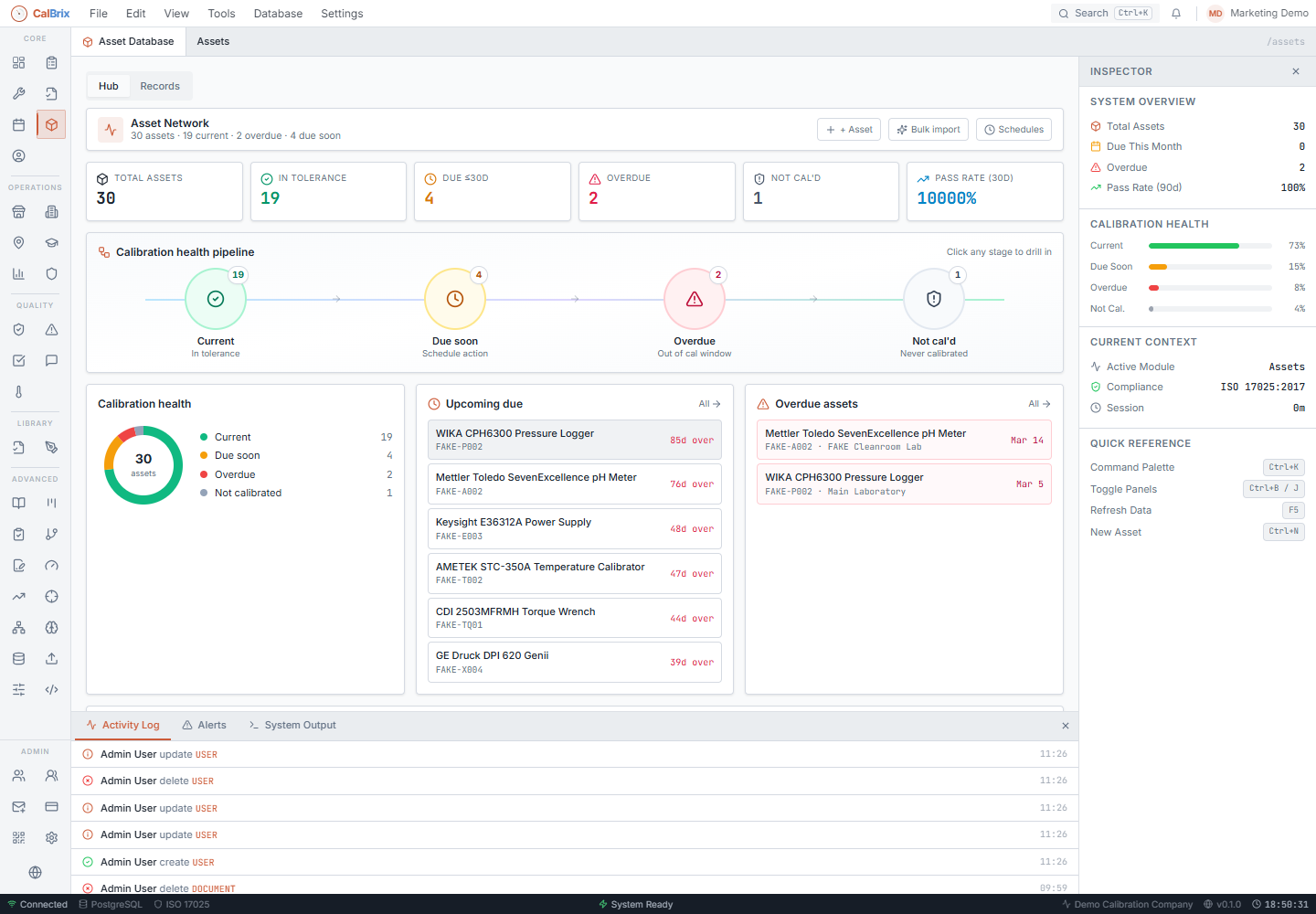
Asset network screenshot from the CalBrix live lab workspace

Demo asset view

Asset network

A screenshot of the demo workspace. Records are synthetic; status totals are not evidence of operational accuracy.

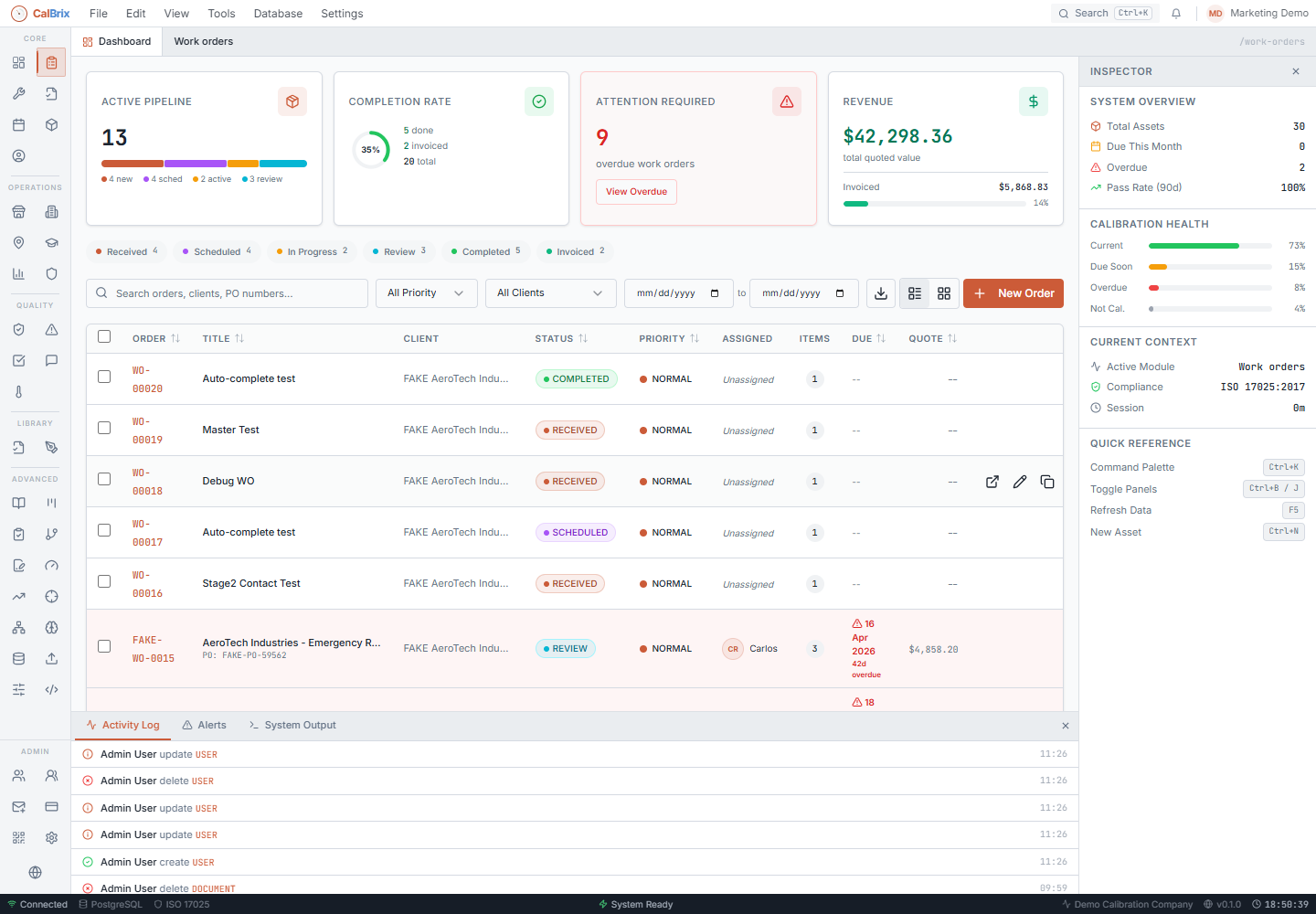
Work order pipeline screenshot from the CalBrix live lab workspace

Operations control

Work order pipeline

A demo work-order view showing sample records, statuses and assignments. Financial workflows were not validated.

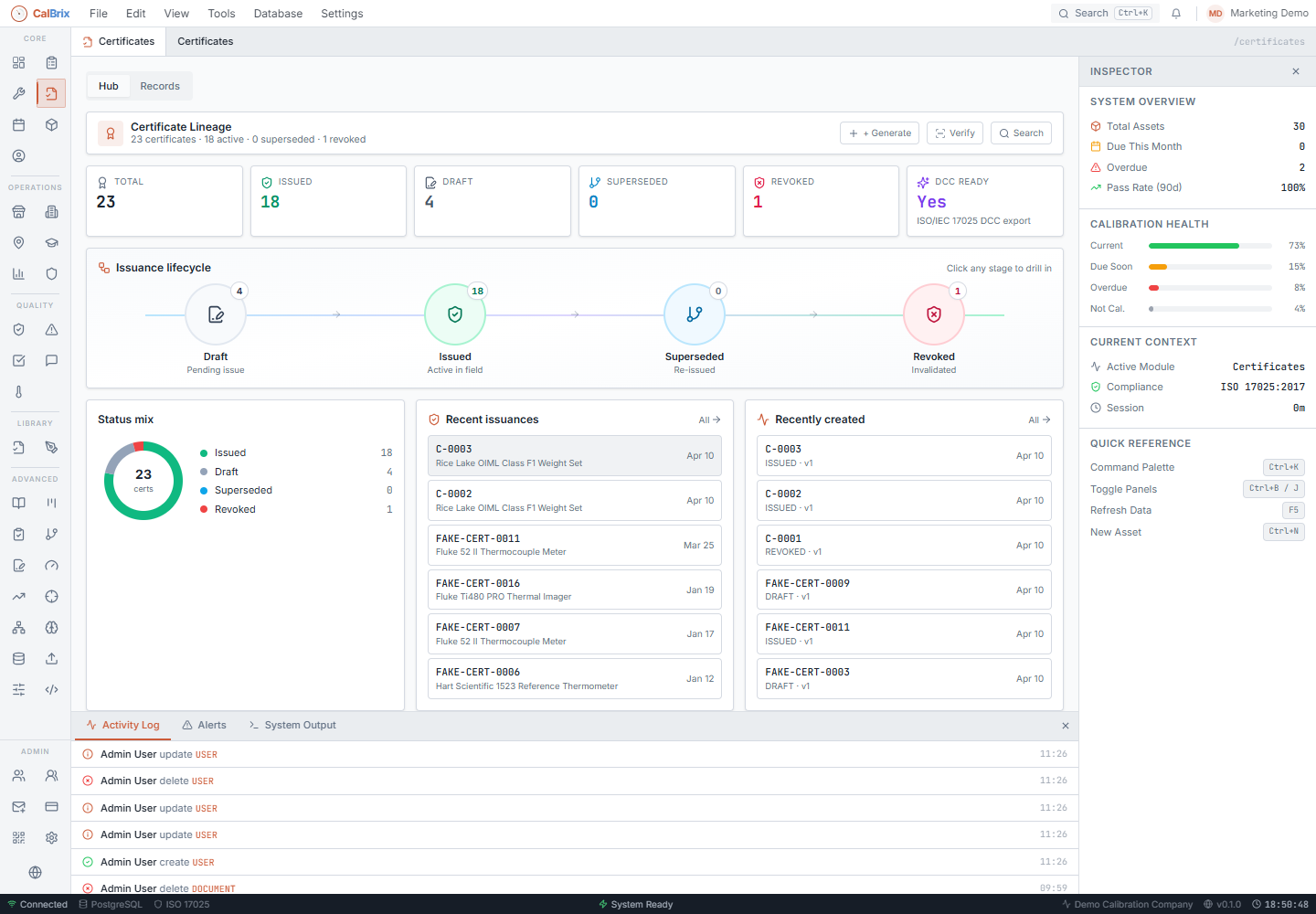
Certificate lineage screenshot from the CalBrix live lab workspace

Release evidence

Certificate lineage

A demo certificate list. PDF issuance was tested; DCC export and signing were not validated.

See it in action

Follow the demonstrated calibration record.

A synthetic work order was completed only after approval and certificate issuance. This is software-workflow evidence, not proof of a valid physical calibration.

1

The demonstrated work order links an instrument, procedure, readings and PDF output.

2

Record associations outside the tested path, including standards history, need further validation.

3

Separate-user authorization and role separation remain to be validated.

Workflow map

A connected path from receipt to release

Controlled flow

Received

Client intake

Asset check

Execute

Procedure run

Measurement capture

Review

Evidence review

Decision comments

Release

Certificate issue

Next interval

Illustrative approval queue

4 records waiting on technical review
2 certificates need signature
1 deviation linked to an out-of-tolerance event

Linked controls

TraceabilityEnvironmental captureReviewer signoffAudit historyCertificate verificationScheduling

Why CalBrix

A working core, with clear limits.

The platform is structured so quality, metrology, and operations teams share one operating picture instead of working from disconnected systems.

1

Structured execution

A procedure-defined five-point worksheet was tested with manual readings, environmental inputs and tolerance checks.

Procedure-based demoOther worksheet paths require testing
2

Certificate release

An approved synthetic calibration produced a signed record, downloadable PDF and public verification page.

Demo PDF outputNot an accredited result
3

Operational planning

Client creation, work orders and an internal-instrument schedule have been exercised. Scheduling and status gaps remain.

Work orders and queuesDue-date reconciliation pending
4

Analytics under evaluation

Selected SPC and Gage R&R examples passed synthetic tests. Predictive drift and complete calculation-method validation are not yet demonstrated.

Selected SPC and MSA testsNot validated decision support
5

Review and approval

Approval and certificate release worked in the demo. Independent reviewer permissions and live collaborative review still need work.

Reviewer workflowsLive collaboration not ready
6

Deployment assessment

Discuss your infrastructure, roles, integrations and data requirements. Security and deployment acceptance must precede production use.

Integration testing requiredPrivate deployment assessment

Evaluation snapshot

Designed around the numbers teams actually watch.

These labels describe the product and its test scope. They are not customer outcomes, uptime commitments or performance benchmarks.

Early access

Product stage

A working core with additional modules at different stages of testing.

6

Illustrated lifecycle stages

The six-stage illustration explains the intended lifecycle; not every stage is validated.

PDF

Certificate release

A certificate download was verified after approval in the synthetic workflow.

Open gaps

Readiness status

Audit integrity, security and operational recovery still require validation.

The difference

What to investigate in your evaluation.

Compare your current process with the demonstrated workflow. Benefits depend on your requirements, configuration and successful acceptance testing.

Possible process challenges
  • Spreadsheets for asset records and calibration history
  • Manual certificate rebuild from worksheet data
  • Approvals via email with no traceable record
  • Audit evidence scattered across five systems
  • Days spent pulling records before an inspection
  • No visibility on overdue assets or schedule risk
  • Uncertainty budgets calculated manually in Excel
  • Certificate errors discovered during or after audits
Evaluation questions
  • Do instrument records and due-date statuses agree with your source records?
  • Does approved-record PDF output meet your certificate requirements?
  • Are independent reviewer permissions and release gates correctly enforced?
  • Can you verify the required references, conditions and record history?
  • Have your quality personnel approved the evidence and validation results?
  • Dashboard totals and due-date status consistency still need reconciliation
  • Have uncertainty and decision-rule calculations been independently checked?
  • Does public verification show the correct record and its limitations?

Founder-led development

Philip Montford

Founder & Lead Engineer, CalBrix

Philip Montford is the founder of CalBrix, with a background in electrical engineering, offshore work and software development.

He is developing CalBrix to connect calibration records, worksheets, review and certificate output. Product claims are tied to current test evidence, not assumptions about competitors.

Engineering background

Electrical engineering and offshore work inform the product direction.

Evidence-led evaluation

Assess CalBrix against your own workflow and acceptance criteria.

Quality requirements

Define and validate the records and controls your quality system needs.

Direct access

Contact the founder to discuss scope and limitations. Support availability must be agreed.

Pricing

Discuss a perpetual-use implementation proposal.

The proposed commercial model is a scoped implementation with perpetual-use licensing. Scope, acceptance gates, operating costs and license terms must be agreed in writing; no software intellectual-property transfer is implied.

1

One-time implementation fee

A proposal can cover setup, configuration, templates, training and handover, subject to feasibility and acceptance.

2

Proposed seat-fee model

The proposed license has no per-user platform fee; confirm limits and terms in your agreement.

3

Proposed output-fee model

No per-certificate platform charge is proposed. Infrastructure capacity and operating costs still apply.

Indicative implementation scopes

Starter scope

From $5,000

Single-site labs and small quality teams.

Professional scope

$10,000 – $15,000

Commercial labs, inspection companies, industrial teams.

Enterprise scope

$20,000 – $25,000+

Complex requirements, subject to assessment.

Potential scope — confirm in writing

  • +Perpetual use license
  • +Deployment and workflow configuration
  • +Certificate template setup
  • +User roles and admin handover
  • +Training and go-live support

Support, upgrades, hosting, and custom work can be arranged separately after handover.

Built for decision-makers

For leaders who own calibration outcomes, not just documents.

Quality and calibration do not break down because people stop caring. They break down when systems lose structure, visibility, and accountable control.

Lab managers

Evaluate how intake, worksheets and approval steps fit your laboratory.

Quality leaders

Review the recorded workflow, current limitations and evidence needed for acceptance.

Operations teams

Assess instrument records, scheduling needs and integration requirements using synthetic data first.

Executive control view

Governance you can explain. Visibility you can act on.

Quality leaders can evaluate the demonstrated records alongside known gaps. Reporting accuracy, audit integrity and permissions require further acceptance testing.

Connected workflows

Work orders, calibration records, reviews, and certificates move together instead of fragmenting across tools.

Planning views to validate

Check displayed totals against source records; current due-date/status inconsistencies remain.

Accountability to verify

Check reviewer permissions and record associations; historical audit mismatches remain.

Inspection requirements

Your quality team must establish which evidence is required and whether the system meets that need.

Market position

Developed in Ghana, open to evaluation enquiries.

CalBrix is being developed with laboratory and industrial workflows in mind, including teams in Ghana and other African markets. We do not claim exclusive market coverage or an absence of competing products.

From setup to go-live

Start with a scoped evaluation of your workflow.

Document your asset structure, certificate format, approval responsibilities and deployment requirements first. Any implementation depends on closing the relevant gaps and passing agreed tests.

+

Workflow mapping

We map your intake, execution, review, certificate release, and recall process before deployment so the system matches how your team actually works.

+

System configuration

We configure assets, users, roles, permissions, certificate templates, and approval paths to fit your operational structure.

+

Data and template setup

Agree a migration plan and test representative imports before transferring live records. General import/export workflows are not yet fully validated.

+

Training and rollout

Training and role-specific acceptance can form part of an agreed implementation scope.

+

Go-live support

Production release follows readiness checks and customer acceptance. Support scope and availability must be agreed.

+

Support after handover

After handover, support, maintenance, upgrades, hosting, and customizations can be discussed separately based on your needs.

Built for procurement, audits, and controlled rollout

Bring your IT, quality and deployment requirements.

CalBrix is built for organizations that need to review security posture, data ownership, deployment model, and compliance alignment before committing to a platform.

Data ownership

Customer data rights remain important. Software use, configuration rights and deployment responsibilities require a written agreement; a perpetual-use model is proposed, not a transfer of intellectual property.

Deployment assessment

Cloud and customer-controlled deployment requirements can be assessed. No air-gap or multi-site production validation is claimed.

Record validation

Review and PDF records are demonstrated; audit-history reconciliation and broader evidence validation remain open.

AI data-flow assessment

The website assistant retrieves curated answers on this server. Product AI, predictive outputs and deployment-wide data flows require separate validation.

Explore CalBrix

Product scope and evaluation resources in one view.

Products, industry fit, compliance posture, and rollout resources are organized so your team can evaluate CalBrix on the dimensions that matter most.

Insights and rollout motion

Practical resources for teams evaluating a calibration platform change.

Whether you are mapping workflows, reviewing compliance fit, or planning a rollout, these resources help your team move from evaluation to decision with confidence.

Playbook

Plan a staged calibration workflow evaluation.

Map intake, execution, review, and release stages around the actual work before migration so adoption tracks with operations.

Explore

Operations

Tie certificates, work orders, and due-date planning into one operating rhythm.

Test client records, due dates and release decisions against your acceptance criteria.

Explore

Compliance

Define the evidence your quality system requires.

Review traceability, signatures, audit history and certificate content with qualified personnel.

Explore

CT-100 field terminal

Explore the Android evaluation build.

An Android APK is available for technical evaluation. Offline sync, NFC, biometric sign-off and the complete device-to-server workflow have not been validated for customer use.

NFC — hardware testing required

Device integration needs hardware-specific testing.

Offline workflow — unvalidated

Sync correctness and conflict recovery remain to be tested.

Biometrics — unvalidated

Biometric identity and record binding are not validated.

GPS workflow — unvalidated

Camera, location and upload behavior require device testing.

Frequently asked questions

Common questions from teams evaluating CalBrix.

Practical answers to the questions that come up most often when teams are considering moving their calibration operations to a new platform.

Is CalBrix built for internal calibration teams or commercial labs?

Both are intended audiences. Current availability is guided demonstration and early-access evaluation, not validated production operation.

How does CalBrix handle audit readiness?

The demo links measurement, environmental and approval records. Historical audit mismatches remain; CalBrix is not currently presented as audit-validated or as certifying compliance.

Can we deploy it inside our own infrastructure?

Private deployment can be assessed during scoping. Your infrastructure, backups, security and any AI data flows must be tested; air-gapped operation is not a validated offering.

Does the platform cover more than certificates and schedules?

Additional modules are present, but their testing status varies. See Product status for the demonstrated paths and unresolved limitations.

What types of teams are usually involved in a rollout?

Lab leadership, quality, operations, and IT typically align on workflow design, data migration, deployment, and approval control. The product is designed to support that cross-functional motion.

Can CalBrix support regulated industries with strict approval requirements?

Regulated use requires deployment-specific validation. Independent reviewer permissions, audit integrity and metrological calculations must be verified before operational reliance.